
A pool in New Jersey gets used maybe four months a year. A spa gets used twelve.
That single fact is why so many homeowners across Essex, Bergen, Morris, Passaic, Hunterdon, and Mercer counties end up asking about a pool and spa combination partway through the design conversation. They came in wanting a pool. They leave wanting something they can actually use in February.
The question is not whether to add a spa. It is how to attach it, and that decision has to happen early. A pool and spa combination is drawn at the design table, not added at the end. Here is how the pool features compare.
Attached Spa: One Structure, One Look
An attached spa shares a wall with the pool. Both are formed as a single gunite structure, finished in the same material, and framed by the same coping.
This is the version most people picture, and it only exists because of custom pool construction. You cannot attach a spa to a manufactured shell and have it read as one design. The shapes have to be drawn together and sprayed together.
The advantage is visual continuity. Nothing looks bolted on. The spa reads as part of the pool rather than as an appliance parked next to it. It also shares plumbing and equipment, which simplifies the mechanical side considerably.
The tradeoff is permanence. A pool and spa combination built this way is not something you reposition later.
Raised Spa: The Pool and Spa Combination That Changes the Whole Yard
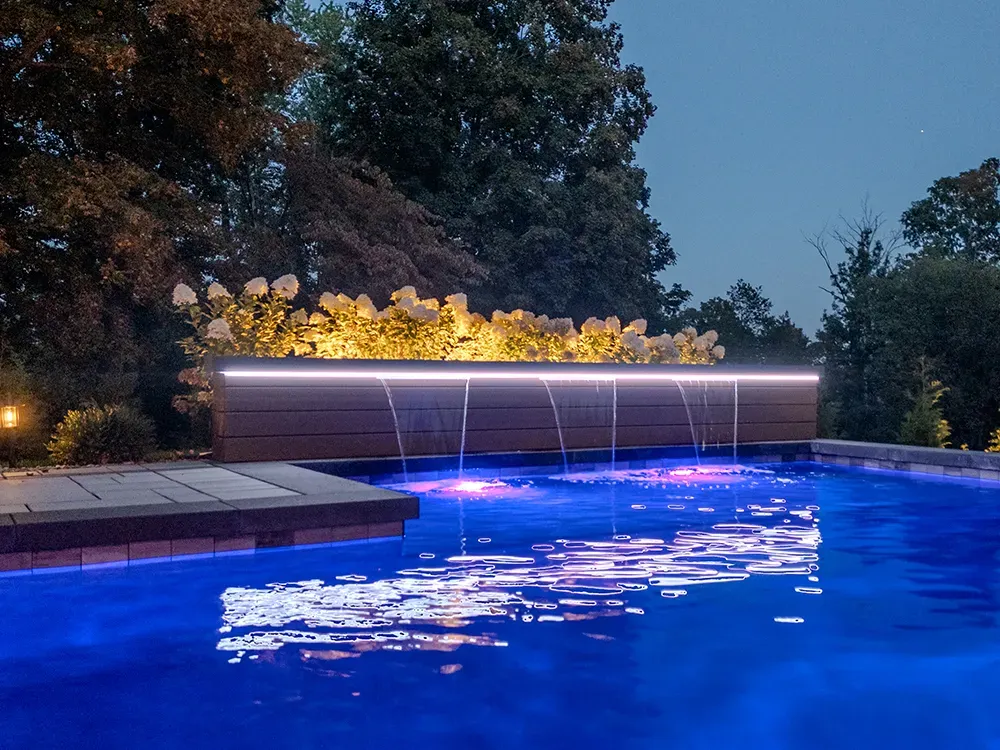
A raised spa sits above the pool waterline, usually eighteen to thirty inches up, with the pool tucked below it.
This does two things at once. It creates a visual anchor at one end of the yard, and it turns the spa wall into a seating edge for the pool. On a sloped property in Mendham or Chester, a raised spa also solves a grade problem that would otherwise need a retaining wall.
The pool patio and surround detailing matters enormously here. The coping, the step up, and the material transition are what make a raised spa look intentional rather than awkward. Get those right and it becomes the best-looking element in the backyard.
The Spillover: Where the Sound Comes From
Most raised and attached spas are designed to spill into the pool. Water flows over a weir edge and falls into the main body.
People install this for the look. They keep it for the sound. A spillover produces steady moving water without the drama of a full waterfall, which is why it works well on smaller lots in Montclair or Glen Ridge where a boulder feature would overwhelm the space.
If you want more, waterfalls and fountains can be layered in alongside the spillover. If you want less, the spillover alone is usually enough.
Standalone Spas and Swim Spas
Not every project needs integration. A standalone spa or swim spa makes sense when the budget is tight, the yard is small, or the homeowner wants the option to take it with them.
Swim spas in particular have a real use case. They give you a current to swim against in a footprint that fits a Wyckoff or Franklin Lakes side yard where a full pool would not.
The honest limitation is that a standalone unit will always look like a unit. It can be screened, decked around, and integrated visually, but a true pool and spa combination is a different product.
Automation Is What Makes It Actually Get Used
Here is what separates spas that get used from spas that sit cold.
If heating your spa means walking outside, opening an equipment panel, flipping a switch, and waiting forty minutes, you will use it in June and forget it by October. If it means tapping your phone from the kitchen while dinner finishes, you will use it in January.
A pool and spa combination without automation is a spa you admire from the window. Modern controllers handle temperature, jets, pool lighting, and saltwater systems from a single interface. Scheduling matters more than people expect. A spa set to hold temperature during the hours you actually use it costs less to run than one heated from cold on demand.
This is worth specifying during swimming pool design, because retrofitting automation into an existing equipment pad is possible but rarely elegant.
Designing for Cold Weather Use
If the spa is meant for winter, the yard around it needs to support that.
Think about the walk from the door. Think about where you set a towel. Think about wind. An outdoor fireplace positioned near the spa extends the usable zone well past the water itself, which is the difference between a quick soak and an actual evening outside.
Homeowners in Hunterdon and Mercer County who plan for winter use at the design stage get far more out of the investment than those who add a spa and hope for the best.
Frequently Asked Questions
Is it cheaper to build a spa with the pool or add it later?
Building together is significantly less expensive. The excavation, plumbing, gunite, and equipment are shared, and the crews are already on site. Adding an attached spa later means reopening the shell and often reworking the equipment pad.
How many people does an attached spa typically hold?
Most custom attached spas are designed for six to eight adults, though the size is entirely up to the design since the shell is formed on site. Larger spas cost more to heat, so seating capacity should match how you actually plan to use it.
Can you add a spa to an existing pool?
Sometimes. It depends on the existing shell construction, the equipment capacity, and whether the yard can accommodate the new structure. A gunite pool is generally the best candidate. Vinyl and fiberglass pools are harder to integrate with.
Does a spa work in a New Jersey winter?
Yes, and that is the main reason to build one. A properly winterized and heated spa runs year-round here. Cover quality, heater sizing, and freeze protection settings are what determine whether it works well or becomes a headache.
What does pool automation actually control?
Typically heat, pumps, jets, lighting, water features, and sanitization, all from a phone app or wall panel. The practical benefit is scheduling, which lowers operating cost and makes spontaneous use realistic instead of a chore.
Thinking about adding a spa to your project?
We design pools and spas as one structure from the first sketch, across Essex, Bergen, Morris, Passaic, Hunterdon, and Mercer counties. Bring us your yard and we will show you what it can hold.
Schedule a Free Design Consultation