
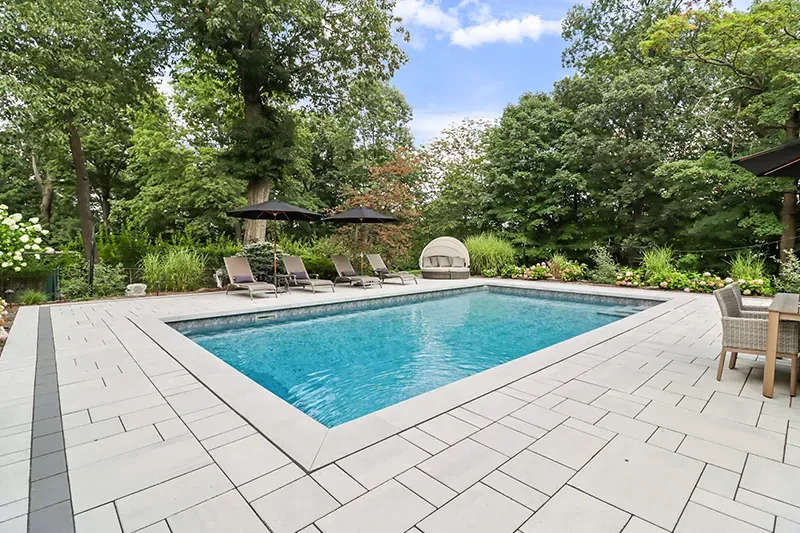
Most homeowners start pool shopping by browsing photos. Then they get their first proposal, see three different construction methods quoted at three very different numbers, and realize nobody explained what they were actually choosing between.
The gunite vs fiberglass pools decision is not really a budget question. It is a question about your yard, your timeline, and how long you plan to live with the result. Vinyl liner belongs in that conversation too. All three build real inground pools. They just solve different problems.
At GD Group, we build across Essex, Bergen, Morris, Passaic, Hunterdon, and Mercer counties, and the right answer changes from one driveway to the next. Here is the honest version.
How Gunite Pools Are Built
Gunite starts with a hole and a steel rebar cage. Concrete is then sprayed under high pressure directly onto that cage, forming a single structural shell that hardens in place. Once it cures, it gets a finish surface, usually plaster, quartz, or pebble.
Because the shell is formed on site, the shape is whatever you draw. That is the entire argument for gunite. There is no catalog and no standard size. A vanishing edge, a raised spa spilling into the main body, a tanning shelf sized to fit two specific lounge chairs, a waterfall built into a boulder wall, all of it is possible because nothing was manufactured in advance.
This is why the design process matters so much with gunite. You are not selecting a model. You are drawing a shape that has to work with your grade, your sightlines, and your setbacks. Our modern swimming pool builds in Wayne and Montclair lean on that freedom heavily.
The tradeoffs are real. Gunite takes the longest to build. The finish is porous, so it needs consistent brushing and water chemistry. Plan on resurfacing somewhere in the ten to fifteen year range, depending on how the pool was cared for.
How Fiberglass Pools Are Built
A fiberglass pool is a one-piece shell molded in a factory and trucked to your property. Excavation happens, the shell is set with a crane, plumbing gets connected, backfill goes in, and the pool fills.
The speed is genuinely impressive. The surface is a smooth gel coat that resists algae, which usually means fewer chemicals and less scrubbing. There is no liner to replace and no plaster to resurface.
The limits are physical. The shell has to fit on a truck and get through your property, so width tops out around sixteen feet in most cases. You choose from what the manufacturer already molds. If your yard in Franklin Lakes has a narrow side gate or mature trees framing the only approach, excavation and site work becomes the deciding factor before anyone talks about pool shape at all.
When people compare gunite vs fiberglass pools purely on price, they usually miss this. Access can quietly disqualify fiberglass on properties where a gunite crew would have no trouble.
How Vinyl Liner Pools Are Built
Vinyl liner pools use steel or polymer wall panels set in the ground, with a custom vinyl membrane stretched across the interior. The liner is the waterproof surface.
Upfront cost is typically the lowest of the three. Shape options are broader than fiberglass because the panels can be configured, though not as open-ended as gunite. The surface is soft underfoot, which some families genuinely prefer.
The long-term math is where it gets interesting. Liners wear and eventually need replacement, generally somewhere in the five to nine year window. That is a recurring cost most first-time buyers do not price in. Our pool renovation crews replace a lot of liners across Hunterdon County, and homeowners are often surprised the second time around.
Gunite vs Fiberglass Pools: The Long-Term Ownership Math
Here is the part most comparison articles skip. Every one of these surfaces interacts with your sanitization choice. Saltwater systems are gentler on skin and eyes, but salt is harder on certain finishes and metal components than many homeowners expect. That conversation should happen before construction, not after.
New Jersey winters add another layer. Freeze and thaw cycles put stress on every pool structure here. Gunite handles it well when the shell was built correctly and the water chemistry stayed reasonable. Fiberglass flexes with temperature change. Vinyl does fine as long as water levels and winterization are managed properly.
So the gunite vs fiberglass pools question really comes down to three things: how custom the design needs to be, how much your property will cooperate with a crane, and whether you are optimizing for the first year or the next twenty-five.
A Simple Way to Decide
Strip the gunite vs fiberglass pools debate down and it resolves into three plain scenarios.
If you want a fully bespoke design with integrated spa, shelf, or edge features, and you have room to work, gunite is the answer. That is what most of our Morris and Bergen County clients are after.
If low maintenance and a fast install matter more than a custom shape, and your property access is clean, fiberglass makes strong sense.
If the upfront number is the constraint and you understand the liner replacement cycle, vinyl is an honest, workable choice. Our swimming pool design team will tell you plainly when that is the smarter call.
There is no universally correct pick. The gunite vs fiberglass pools comparison only resolves once someone stands in your backyard. There is only the option that matches your lot and your patience. Homeowners across Passaic and Mercer counties land in all three camps every season, and they are all right.
Frequently Asked Questions
Are gunite pools worth the extra cost in New Jersey?
They usually are when the design is genuinely custom or the yard is unusual. Gunite lets you build around slope, odd shapes, and integrated features that fiberglass and vinyl simply cannot accommodate. If a standard rectangle would make you happy, the premium is harder to justify.
How long does each pool type take to build?
Fiberglass is fastest, often a few weeks once the shell arrives. Vinyl liner typically falls in the middle. Gunite takes the longest because the shell has to cure and the finish work is done on site. Weather, permits, and rock all extend those windows in New Jersey.
Can you build a fiberglass pool in any backyard?
No. The shell arrives in one piece and needs crane access plus a clear path. Tight lots, steep driveways, overhead wires, and mature trees frequently rule it out. That is often the single fastest way to narrow the gunite vs fiberglass pools decision.
Which pool type lasts the longest?
A properly built gunite shell has the longest structural life and can be resurfaced repeatedly rather than replaced. Fiberglass shells are durable but cannot be reshaped. Vinyl requires liner replacement on a recurring cycle, which affects total cost of ownership more than most buyers expect.
Does saltwater damage gunite pools?
Not inherently, but salt is more demanding on plaster finishes and metal fittings than standard chlorine. It is very manageable when the finish and equipment are specified for it from the start, which is why the decision belongs in the design phase.
Not sure which build method your yard can actually support?
We will walk your property, look at access, grade, and drainage, and tell you honestly which of the three makes sense. No obligation, and no pressure toward the most expensive option.
Schedule a Free Design Consultation